Covering a Power Invoice Without Selling: A 495 TH/s Case
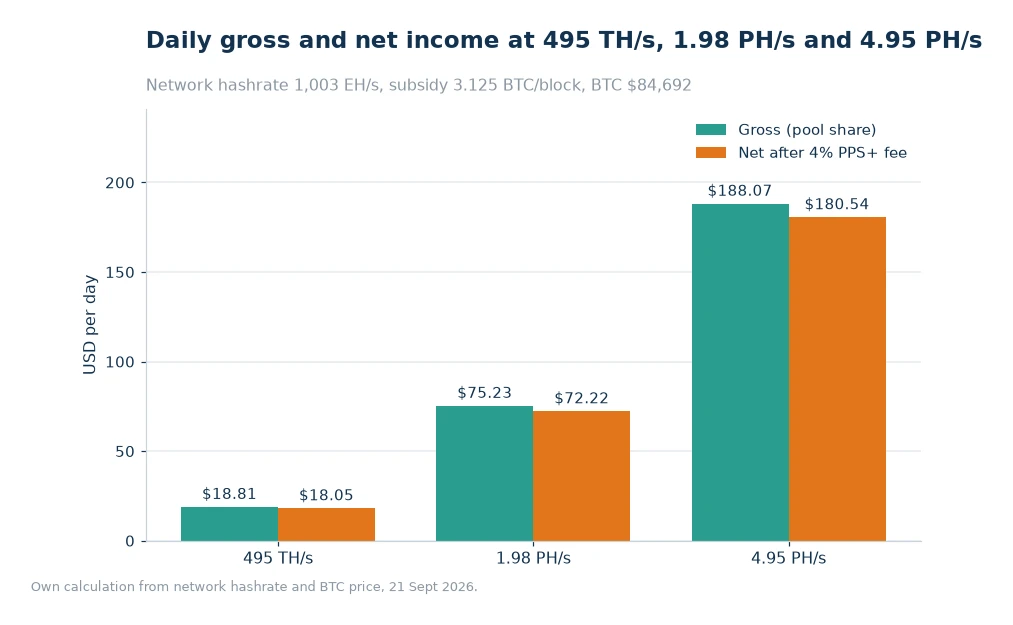
Electricity is billed monthly and mining pays hourly, but the two calendars still collide when a quarter's power invoice lands before the coins have accumulated. At 495 TH/s the net output is $18.05 a day, or $126.35 a week, against a $1,000 invoice that arrives in one envelope. The question is how to bridge that gap without dumping BTC at whatever price the morning offers.

Key takeaways
- 495 TH/s nets $18.05 a day, so a $1,000 power invoice is 55.4 days of output.
- Four weeks of production covers only 50.5% of that invoice at the chart rate.
- Pledged BTC can bridge the gap while the machines keep working; selling closes the gap permanently.
- The repayment plan needs a buffer for a difficulty rise, not just for a price fall.
Why the invoice and the payout rarely line up
Hosting contracts and utility meters run on monthly or quarterly cycles. Mining output arrives continuously and is usually withdrawn when it clears a threshold, which is a different rhythm. In a steady month the mismatch is invisible. In a month with a repair, a heat wave or a short billing cycle, the invoice can arrive before the balance does, and the operator reaches for the coin holding.
Selling solves the timing problem and creates a different one. The coins leave, and the position shrinks exactly when the machine is least productive. If the site is going to keep running for years, that is a poor trade: the asset was held for the long run and sold for a short-run gap. A secured loan against part of the holding keeps the position and moves the gap onto a schedule.
Sizing the loan against daily output
Work from the net figure, not the gross. At 495 TH/s, 0.00022206 BTC a day is $18.81 before fees and $18.05 after the listed 4% on the block-reward component. A $1,000 invoice divided by 18.05 is 55.4 days. That number is the honest measure of the gap, and it should sit beside the loan term before anything is pledged.
The mistake to avoid is borrowing against gross output and repaying from net output. The difference looks small at 4%, but it compounds over a term: on $1,000 of repayment, planning on gross figures leaves roughly $40 unaccounted for by the end. Use the lower number for every date in the plan.
Then add the buffer. Power prices move, difficulty moves and a fan failure costs money. A repayment schedule that consumes every dollar of output has no room for any of those, and the first surprise pushes the operator back to selling coins, which was the outcome the loan was meant to avoid.
The five-step path and where it can stall
Collateral-Pledged Loans are structured as a sequence, and each step has a failure mode worth knowing. Add Collateral locks the coins. Apply for Loan sets amount and term. Receive Loan delivers the cash. Repay Loan clears the balance over time. Redeem Collateral returns the coins once nothing is owed.
The stalls happen at the edges. Add Collateral can fail if the coins sit in a different sub-account. Apply for Loan can be rejected if the requested amount is large relative to the pledged value. Repay Loan can be delayed by a missed payout address. Redeem Collateral is impossible until the last instalment clears, which is why the term must fit the machine's expected working life rather than the operator's optimism.
Before pledging, read the fee page and the loan page together. The ViaBTC Crypto Loan terms decide the cost of the bridge; the fee schedule decides what the machines earn while the bridge is open. Both numbers belong in the same spreadsheet.
| Week | Net output | Cumulative | Share of invoice |
|---|---|---|---|
| 1 | $126.35 | $126.35 | 12.6% |
| 2 | $126.35 | $252.70 | 25.3% |
| 3 | $126.35 | $379.05 | 37.9% |
| 4 | $126.35 | $505.40 | 50.5% |
A useful discipline is to keep the loan and the mining account separate in your own notes even when they share a login. One column records the obligation: amount, term, instalment dates. The other records production: daily net, cumulative and the gap to the next invoice. When the two columns are visible side by side, a shortfall shows up weeks before it becomes a missed payment.
When the difficulty estimate moves against you
Difficulty is the variable that quietly rewrites a repayment schedule. The reading on 21 Sept 2026 put the next adjustment estimate at −2.12%, which would lift output per terahash by roughly 2.17% because the same 450 daily BTC is shared among slightly less work. A fall helps the borrower. A rise of the same size hurts by about the same amount.
Treat the estimate as a sensitivity, not a promise. Run the repayment calendar three times: once at current difficulty, once 5% harder and once 5% easier. If the schedule only works in the easiest case, it is too tight. If it survives the hardest, the loan is doing its job as a bridge rather than as a bet on the next adjustment.
There is a second-order effect worth noting. A difficulty rise does not change the invoice, so the share of output consumed by power grows even though nothing about the site has changed. That is why the buffer belongs in the plan from day one rather than being added after the first difficult month.
Worked example
Follow 495 TH/s from the network totals to the week-four figure in the table.
- The per-terahash rate is 450 ÷ 1,003,000,000, which comes to 0.00000044865 BTC a day.
- At 495 TH/s: 495 × 0.00000044865 = 0.00022208 BTC, shown as 0.00022206.
- At $84,692: 0.00022208 × 84,692 = $18.81 gross.
- Less the listed 4%: 18.81 × 0.96 = $18.06, rounded to $18.05.
- Seven days: 18.05 × 7 = $126.35.
- Four weeks: 126.35 × 4 = $505.40, which is 50.5% of the $1,000 invoice.
- The remaining $494.60 is 27.4 days of net output, or the amount the loan has to bridge.
That last line is the useful one. The loan does not need to cover the whole invoice; it needs to cover the part that arrives before the coins do, plus a margin for a slower month. Borrowing $500 against pledged BTC is a much smaller obligation than borrowing $1,000, and it still solves the timing problem.
Frequently asked questions
How many days of output does a $1,000 invoice represent at 495 TH/s?
At $18.05 net a day, $1,000 is 55.4 days of output. Four weeks of production covers $505.40, or 50.5% of the invoice, which is the gap a short loan is meant to bridge.
Should the loan cover the whole invoice or just the gap?
Borrow only the part that arrives before the coins do, plus a margin for a slow month. Covering the whole invoice turns a timing fix into a larger obligation, and the interest is paid on money that was never needed.
What if difficulty rises during the repayment term?
Output per terahash falls, so each instalment takes longer to earn. Test the schedule at 5% harder difficulty before pledging; if it only works at today's reading, either borrow less or extend the term.
Book the repayment before the invoice
Put the power invoice date, the first repayment date and the last repayment date in the same calendar, then check the ordering. The first repayment should fall after the invoice is settled and the last should fall inside the term. If either is wrong, adjust the amount rather than the dates, because dates are fixed by contracts and amounts are not.
The multi-currency wallet shows both sides of the position: the pledged balance and the cash that arrived. Watching them together for the first month is the simplest way to confirm that the bridge is working as designed and not slowly turning into a sale.
Sources: the ViaBTC loan, pricing and wallet pages for product steps, listed rates and account structure[1]. Readings taken 21 Sept 2026 — hashrate 1,003 EH/s, difficulty 132.76 T, subsidy 3.125 BTC every block, 144 blocks daily, BTC $84,692, next adjustment estimated at −2.12%. Published 24 Oct 2026.