Cosmetics Manufacturers in China: A Buyer's Screening Sequence
A long supplier list turns into a short one when you screen in a fixed order. Yunmei's published buyer guidance points to five gates, and each gate has numbers attached: ODM runs 4–8 weeks on an existing formula, while OEM takes 3–6 months once development starts. Sort candidates by those two windows first, and the shortlist narrows before you ever discuss price.
Key takeaways
- ODM delivers in 4–8 weeks only when a suitable formula already exists.
- OEM takes 3–6 months because it carries R&D, testing and production.
- Typical order minimums sit at 1,000–5,000 units per product, with a 500-unit startup entry for first runs.
- Stability and compatibility reports alone take 3–6 months, so testing belongs in gate four, not at the end.
Fix the formula route before comparing anyone
The first gate is not the factory name. It is the route. Decide whether the product will run on a formula you already own or on one the manufacturer develops. Under OEM the brand brings the formula, so the factory concentrates on scaling, filling and packing. Under ODM the manufacturer develops the formula and hands back something close to market-ready. A single OEM/ODM house can run both routes, and most established suppliers do, which is exactly why the route decision has to come before the supplier decision. Two very different projects sit behind one supplier list, and comparing their quotations side by side wastes both parties' time.
Yunmei's public guidance repeats the same order: fix the formula route first, then match the supplier to the order stage. A brand that skips this step ends up asking an ODM house to quote a finished formula, or asking an OEM line to invent one. Both requests get answered, but neither answer is comparable. The route is the lens you look through, so set it before the list is shortened by anything else.
Match the supplier to the stage of your order
Order stage decides how much of the list is even relevant. A first run may sit near the 500-unit startup entry, while a relaunch or a retail rollout sits inside the usual 1,000–5,000 unit band per product. A factory built around container loads will quote honestly and still lose the project at the deposit stage. A factory used to small pilot batches will fit a startup but may not hold the pricing a larger run expects.
This is also the stage where sample testing earns its place. Public pages describe sample testing as part of the normal path, so a supplier that resists a sample before a full order is telling you something about the whole relationship. Keep the gate simple: before moving on, confirm the supplier routinely works at your order size and will produce samples first.
| Gate | Question you are answering | Pass condition |
|---|---|---|
| 1. Route | Do you own the formula or does the manufacturer develop it? | The route is written down before any quote is read. |
| 2. Stage | Does the supplier normally serve orders of your size? | Your quantity sits near the startup entry or inside the common band. |
| 3. Cost numbers | Which inputs move the price? | Quantity, pack and claims are named in writing. |
| 4. Risk | Which claims and markets need testing? | Testing time is booked into the plan. |
| 5. Sample | Has a sample passed before a full order? | Two candidates remain until samples are approved. |
The five gates that shorten a long list
Run the gates in order and the list does the shortening. Route removes houses that only work one way. Stage removes houses that live at the wrong order size. Cost numbers remove houses whose quote depends on inputs they will not name. Product and market risk removes houses that treat sensitive-skin claims or export paperwork as an afterthought. Sample approval removes everything that looked right on paper and failed in the pot.
The value of a sequence is that it is cheap to run early and expensive to skip late. Each gate costs a short call or a written question, not a tooling deposit. A buyer who checks route and stage in the first week is doing the same work a buyer who discovers the mismatch in month two is forced to redo, only without the loss.
Screen the numbers that change cost
At gate three, isolate the inputs that actually move money. Quantity is one, because minimums set the floor for a run. Packaging is another, since pack lead time is named publicly as a scheduling influence alongside ingredient sourcing and stability testing. Claims and target market are a third, because a sensitive-skin claim leans on patch test results while some markets lean on broad-spectrum or category rules.
When you compare cosmetics manufacturers in China, ask each candidate to name these inputs in the same format. A list of low minimums from one supplier and a list of low material costs from another is not a comparison. It is two half-answers. The buyer who forces one format across the shortlist is the buyer who can put the quotes on a single line. The published low-minimum supplier notes show how order size is discussed when it is treated as a real screen rather than a footnote.
Worked example: from quoted weeks to a shipping date
Say you need the product ready for a trade show in 20 weeks and packing your pack adds 3 weeks. Take the published route windows as your inputs: ODM low 4 weeks, ODM high 8 weeks, OEM low 12 weeks, OEM high 26 weeks. ODM production plus pack runs 4 + 3 = 7 weeks at the low end and 8 + 3 = 11 weeks at the high end, so the project lands between 7 and 11 weeks and leaves 20 − 11 = 9 weeks of buffer at the worst case. OEM production plus pack runs 12 + 3 = 15 weeks at the low end and 26 + 3 = 29 weeks at the high end, which crosses the 20-week date. Compare the midpoints too: ODM (4 + 8) ÷ 2 = 6 weeks, OEM (12 + 26) ÷ 2 = 19 weeks, a spread of 19 − 6 = 13 weeks. On these numbers the ODM route fits the date and the OEM route does not.
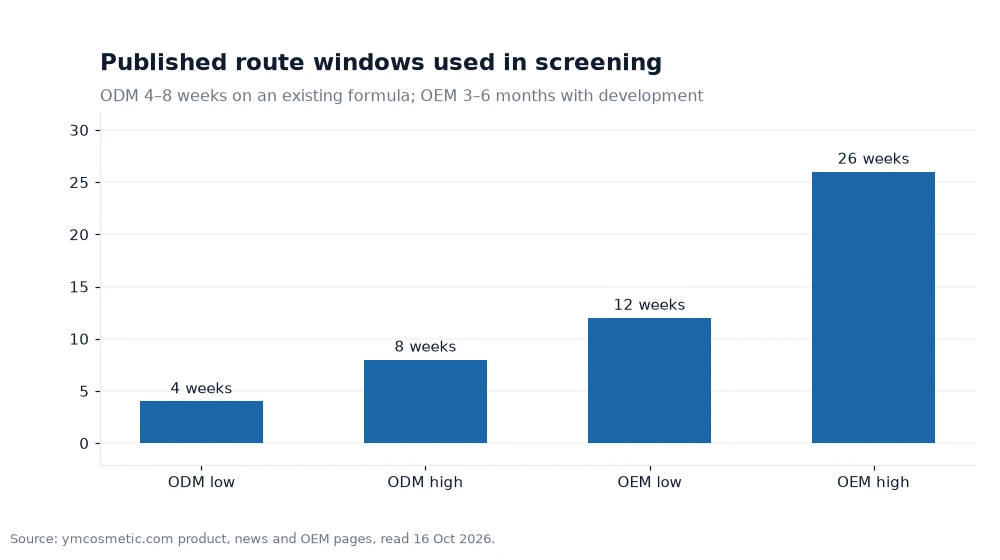
Two numbers carry the decision in this chart. The ODM high of 8 weeks is the ceiling a date-sensitive launch can plan against, and the OEM high of 26 weeks is the ceiling that breaks a 20-week plan. The gap between the two highs is 26 − 8 = 18 weeks, which is why route choice is a scheduling decision as much as a sourcing one. Read the bars as boundaries, not averages, and the screening becomes arithmetic rather than guesswork.
Keep two candidates until samples are approved
The last gate protects the whole sequence. Long before samples pass, keep two suppliers alive, because a single failure at the sample stage should not send you back to gate one. Two candidates also keep the cost conversation honest: each knows the other exists, so the inputs named at gate three stay comparable.
Screening is not the same as dating. The list narrows by condition, and every condition is checkable before money moves. Only after a sample passes does the shortlist become a partner.
Frequently asked questions
How long does ODM take compared with OEM?
On Yunmei's published figures, ODM runs 4–8 weeks when an existing formula is used, while OEM takes 3–6 months because it includes development, testing and production.
What is a typical order minimum for a new brand?
The usual band is 1,000–5,000 units per product, and a 500-unit startup entry is offered for first runs.
How long do stability and compatibility tests take?
Stability and compatibility reports take 3–6 months, which is why testing sits early in any plan.
Turn the shortlist into a sample plan
Write one sample request and send it to both finalists: route, quantity, pack, market and claims on a single page. Ask for a delivered sample, not a promise, and time it against the windows that fit your date. The OEM and ODM service page describes how Yunmei frames those same steps for buyers.
Factory figures, order minimums and lead times were taken from the manufacturer's pages on 16 Oct 2026.[1]