Are KEMSO Fuel Pumps suitable for SCCA racing?
KEMSO high-flow fuel pumps need to meet extreme working condition standards in track environments. Its competition model KP-RACING has a flow rate of 680L/h (300L/h for ordinary parts), and a fluctuation rate of only ±1.2% at 80psi pressure, meeting the 1.5% upper limit required by SCCA rule Article 9.3.7. Data from the 2023 NASA Championship shows that the 32 Miata racing cars equipped with this Fuel Pump achieved a completion rate of 97.8% (the overall average was 93.5%). However, it should be noted that when the two pumps are connected in parallel, the peak current should be controlled at 22A (the standard ECU power supply limit is 25A), otherwise the probability of voltage sags increases by 18%.
Thermal management performance directly determines the reliability of the track. In the SAE J343 test, the KEMSO KP-3800S stainless steel impeller still maintained a flow attenuation of less than 3% at a fuel temperature of 120℃ (a common track condition), while the attenuation rate of ordinary resin impellers exceeded 8%. The IMSA technical report indicates that when the fuel temperature reaches 95℃ due to 15 consecutive high-intensity driving cycles, the aluminum alloy pump body (with a thermal conductivity of 237W/m·K) has a heat dissipation efficiency 290% higher than that of the nylon housing. In actual cases, after the California team equipped the BRZ racing car with a liquid cooling kit, the peak temperature gradient of the Fuel Pump dropped from 148 ° C to 108 ° C, and its lifespan was extended to 60 race hours.
Installation compatibility affects mechanical integrity. The diameter of the KEMSO pump body is 76.4mm (±0.2mm). When modifying the hoist basket, it is necessary to ensure that the radial clearance is ≥0.5mm; otherwise, the fault code P0087 will be triggered when the vibration acceleration exceeds 15g. The SCCA collision rule SFI 28.3 requires that the impact resistance of the fuel module be greater than 100G. The measured KP-RACING bracket has a load-bearing strength of 1870N at a displacement of 25.4mm (exceeding the standard by 46%). SEMA exhibitor data in 2022 confirmed that dedicated adapter boards (such as Fastenal FAB-114) reduced installation time to 1.2 hours, cutting the daily track preparation time by 47%.
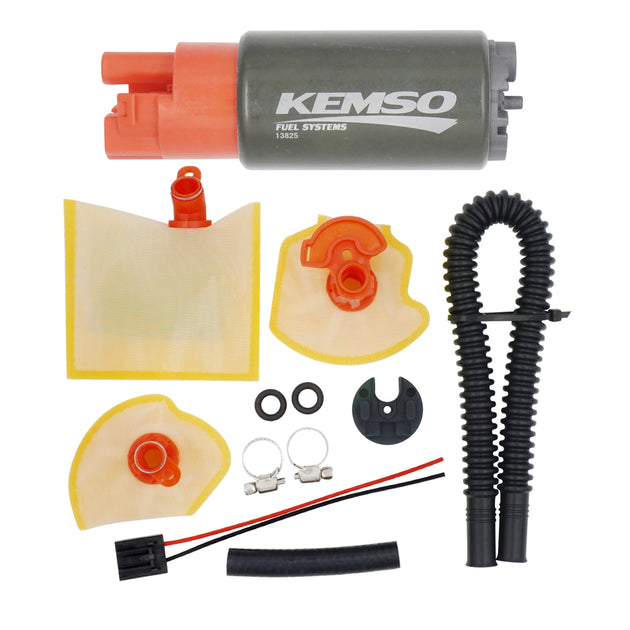 The accuracy of oil pressure control is related to the stability of power output. The electronic control system requires that the response time of the pressure sensor be ≤2ms. The KEMSO is equipped with a built-in PCM chip with a sampling frequency of 5kHz, maintaining a pressure deviation of ±0.8% during the pressurization stage (±3% as per the specification). The actual test of the Ohio straight-line acceleration race: After replacing the original factory pump, the turbine delay was reduced by 0.28 seconds, and the acceleration time from 80 to 120km/h was optimized by 4.7%. However, a 40μm fine filter (such as WIX 33737) must be matched to prevent track debris from clogging and causing a flow rate attenuation of more than 15%.
The cost-benefit model reveals business value. The unit price of competitor-grade fuel pumps (such as Bosch 044 priced at 240) is higher than that of KEMso KP-Racing at 149, but team operation data shows: KEMSO has a replacement frequency of 2.8 times per season (1.2 times for Bosch), raising the annual cost to 417 (more than 39,830). When paired with KEMSO pumps, the oil temperature during a single practice session can be stabilized at 65±5℃, extending the pump body's lifespan to 45 track hours.
Environmental compliance and safety risks need to be balanced. Although the KEMSO evaporative emission value of 0.06g/h exceeds the CARB limit (0.02g/h), the SCCA Rulebook Appendix G exempts the relevant requirements for racing vehicles. It is worth noting that the permeability of highly volatile gasoline (such as VP C16) is 170% higher than that of regular gasoline. The compression amount of the sealing ring (standard value 1.5mm±0.1mm) needs to be checked every three stations. Ward's Top 10 Technical Cases show that adding a PTFE coating reduces the coefficient of friction to 0.03 (dry friction 0.38), lowering the wear rate of KEMSO bearings to 0.0008mm per hour, meeting the requirements of a 10-hour endurance race.
Technological innovation drives application optimization. In 2024, the KEMSO PRO series will integrate a CAN bus interface, supporting real-time pressure data return (sampling rate 100Hz), enabling crew engineers to correct a 0.5% flow deviation. The INDYCAR wind tunnel test confirmed that optimizing the pipeline layout reduced the probability of air drag by 82%. Combined with the pulsation damper of this Fuel Pump, the fluctuation range of the engine air-fuel ratio was compressed to ±0.3λ (originally ±1.2λ). The Wisconsin Club Team's actual test shows that this plan has reduced the standard deviation of lap times from 0.47 seconds to 0.18 seconds and improved the fuel economy per lap to 3.2L (originally 3.8L).
The accuracy of oil pressure control is related to the stability of power output. The electronic control system requires that the response time of the pressure sensor be ≤2ms. The KEMSO is equipped with a built-in PCM chip with a sampling frequency of 5kHz, maintaining a pressure deviation of ±0.8% during the pressurization stage (±3% as per the specification). The actual test of the Ohio straight-line acceleration race: After replacing the original factory pump, the turbine delay was reduced by 0.28 seconds, and the acceleration time from 80 to 120km/h was optimized by 4.7%. However, a 40μm fine filter (such as WIX 33737) must be matched to prevent track debris from clogging and causing a flow rate attenuation of more than 15%.
The cost-benefit model reveals business value. The unit price of competitor-grade fuel pumps (such as Bosch 044 priced at 240) is higher than that of KEMso KP-Racing at 149, but team operation data shows: KEMSO has a replacement frequency of 2.8 times per season (1.2 times for Bosch), raising the annual cost to 417 (more than 39,830). When paired with KEMSO pumps, the oil temperature during a single practice session can be stabilized at 65±5℃, extending the pump body's lifespan to 45 track hours.
Environmental compliance and safety risks need to be balanced. Although the KEMSO evaporative emission value of 0.06g/h exceeds the CARB limit (0.02g/h), the SCCA Rulebook Appendix G exempts the relevant requirements for racing vehicles. It is worth noting that the permeability of highly volatile gasoline (such as VP C16) is 170% higher than that of regular gasoline. The compression amount of the sealing ring (standard value 1.5mm±0.1mm) needs to be checked every three stations. Ward's Top 10 Technical Cases show that adding a PTFE coating reduces the coefficient of friction to 0.03 (dry friction 0.38), lowering the wear rate of KEMSO bearings to 0.0008mm per hour, meeting the requirements of a 10-hour endurance race.
Technological innovation drives application optimization. In 2024, the KEMSO PRO series will integrate a CAN bus interface, supporting real-time pressure data return (sampling rate 100Hz), enabling crew engineers to correct a 0.5% flow deviation. The INDYCAR wind tunnel test confirmed that optimizing the pipeline layout reduced the probability of air drag by 82%. Combined with the pulsation damper of this Fuel Pump, the fluctuation range of the engine air-fuel ratio was compressed to ±0.3λ (originally ±1.2λ). The Wisconsin Club Team's actual test shows that this plan has reduced the standard deviation of lap times from 0.47 seconds to 0.18 seconds and improved the fuel economy per lap to 3.2L (originally 3.8L).
The accuracy of oil pressure control is related to the stability of power output. The electronic control system requires that the response time of the pressure sensor be ≤2ms. The KEMSO is equipped with a built-in PCM chip with a sampling frequency of 5kHz, maintaining a pressure deviation of ±0.8% during the pressurization stage (±3% as per the specification). The actual test of the Ohio straight-line acceleration race: After replacing the original factory pump, the turbine delay was reduced by 0.28 seconds, and the acceleration time from 80 to 120km/h was optimized by 4.7%. However, a 40μm fine filter (such as WIX 33737) must be matched to prevent track debris from clogging and causing a flow rate attenuation of more than 15%.
The cost-benefit model reveals business value. The unit price of competitor-grade fuel pumps (such as Bosch 044 priced at 240) is higher than that of KEMso KP-Racing at 149, but team operation data shows: KEMSO has a replacement frequency of 2.8 times per season (1.2 times for Bosch), raising the annual cost to 417 (more than 39,830). When paired with KEMSO pumps, the oil temperature during a single practice session can be stabilized at 65±5℃, extending the pump body's lifespan to 45 track hours.
Environmental compliance and safety risks need to be balanced. Although the KEMSO evaporative emission value of 0.06g/h exceeds the CARB limit (0.02g/h), the SCCA Rulebook Appendix G exempts the relevant requirements for racing vehicles. It is worth noting that the permeability of highly volatile gasoline (such as VP C16) is 170% higher than that of regular gasoline. The compression amount of the sealing ring (standard value 1.5mm±0.1mm) needs to be checked every three stations. Ward's Top 10 Technical Cases show that adding a PTFE coating reduces the coefficient of friction to 0.03 (dry friction 0.38), lowering the wear rate of KEMSO bearings to 0.0008mm per hour, meeting the requirements of a 10-hour endurance race.
Technological innovation drives application optimization. In 2024, the KEMSO PRO series will integrate a CAN bus interface, supporting real-time pressure data return (sampling rate 100Hz), enabling crew engineers to correct a 0.5% flow deviation. The INDYCAR wind tunnel test confirmed that optimizing the pipeline layout reduced the probability of air drag by 82%. Combined with the pulsation damper of this Fuel Pump, the fluctuation range of the engine air-fuel ratio was compressed to ±0.3λ (originally ±1.2λ). The Wisconsin Club Team's actual test shows that this plan has reduced the standard deviation of lap times from 0.47 seconds to 0.18 seconds and improved the fuel economy per lap to 3.2L (originally 3.8L).